Tag Archive | "lg"

LG Spectrum Unboxing and Overview [video]

Tags: , , , ,


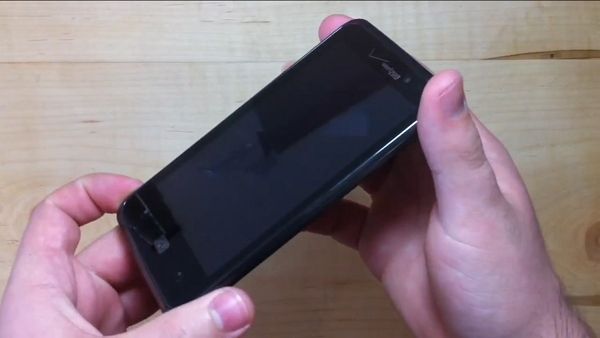
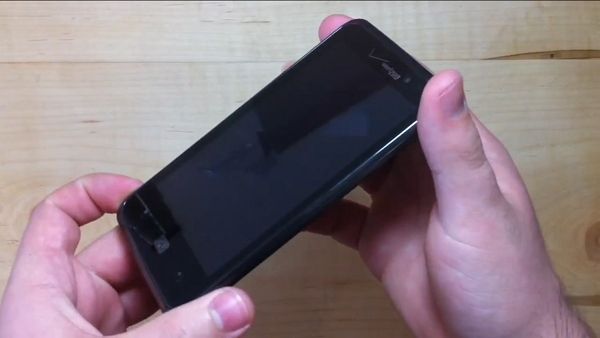
We have the LG Spectrum on hand at Carrypad HQ to give you review coverage of this huge 4.5″ phone. First thing first, here’s the unboxing and overview:

The LG Spectrum is one of the last big releases from LG before the company switches up the styling of their devices to something they’re calling ‘L-style’. Hopefully it will be an improvement, as the LG Spectrum feels a big bulky even if it is relatively thin.

LG Announces Optimus 4X HD With Quad-core Tegra 3

Tags: , , , , , ,


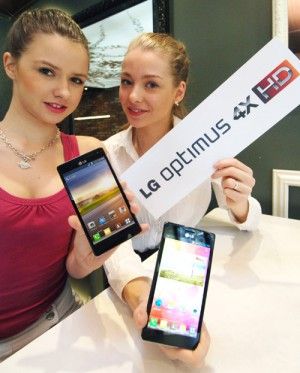
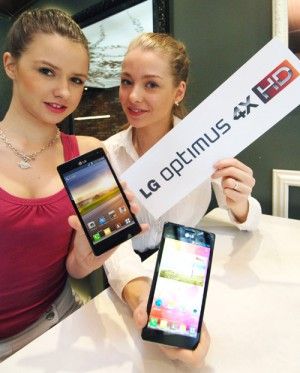
LG has announced, and will be showing off at MWC (starting tomorrow), the Optimus 4X HD. This is LG’s first quad-core phone and uses the Nvidia Tegra 3 platform. It’s likely that we’ll see a number of Tegra 3 smartphones announced and shown at MWC this year. Tegra 3 has actually been on the market for a few months in the form of the Asus Transformer Prime, but we’ve yet to see it available in phone-form.

I’m happy to report that the Optimus 4X HD comes pre-installed with Android 4.0 Ice Cream Sandwich which will help really make use of the 1.5GHz quad-core CPU which is equipped with 1GB of RAM. There is 16GB of in-built memory, and the screen is a monster 4.7″ 1280x720p IPS display which, if anything like the LG Spectrum’s screen, is sure to please in terms of colors and sharpness. There’s an 8MP camera on the back and a 1.3MP camera in the front. Additionally, the phone is equipped with 4G LTE; LG will have to be really careful with this phone to ensure that it has reasonable battery life. The battery capacity is 2150mAh.

Chippy is on the show floor at MWC starting tomorrow, stay tuned for more!


LG Announces the Optimus Vu, 5″ Android Smartphone With a Unique Aspect Ratio

Tags: , , , , , ,


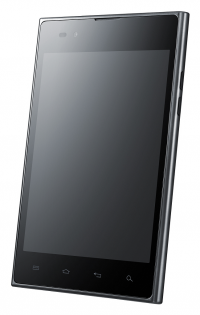
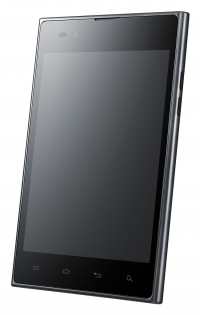
LG has announced the Optimus Vu a week ahead of the upcoming Mobile World Congress convention where they plan to show off the new phone. The Optimus Vu is a massive 5″ phone with a 4:3 aspect ratio — significantly more square than your typical 16:9 Android smartphone. This leaves it with a curious 1024×768 resolution. Exactly how Android applications will take to this non-standard resolution is unclear — though I was impressed with how well Android managed to scale applications to the likes of the HTC Status which has an odd 2.6″ screen with a 480×320 resolution. While I’ve argued that more square screens make for a better one-handed smartphone experience with Android, at 5″ the 4:3 ratio is not likely to help this very much.

LG says that the phone will launch running Android 2.3, but Android 4.0 Ice Cream Sandwich is already in the works. LG is billing the Optimus Vu as a device that could be useful for note-taking, but make no mention of an active digitizer screen such as those found on the HTC Flyer and Samsung Galaxy Note. Presumably then, the Optimus Vu will rely on a standard captive touchscreen which won’t be as accurate or smooth for digital note-taking or support palm-rejection. The company will be offering a “Rubberdium” stylus (presumably capacitive) with the Optimus Vu, though it isn’t clear whether or not this will be an included accessory or a separate purchase. LTE is included for 4G data access.

LG makes no mention of whether or not the Optimus Vu will be launched outside of Korea, where it is set to become available in March.

Specs we know so far:

  • Chipset: 1.5GHz Dual-Core Processor
  • Display: 5-inch (1024×768) IPS Display
  • Memory: 32GB eMMC and 1GB DDR2
  • Camera: 8MP with AF LED Flash (rear) and 1.3MP (front)
  • OS: Android 2.3 Gingerbread (upgradable to Android 4.0 ICS)
  • Battery: 2,080mAh
  • Dimension (L x W x D): 139.6 x 90.4 x 8.5mm
  • Connectors: HDMI (unspecified socket type)

As mentioned, LG will have the Optimus Vu on display at MWC next week, so stay tuned for more specs and info coming soon.

More photos below:

Report: Smartphone Screens Growing over Time, 5″ Screens the Norm by End of 2013

Tags: , , , , , , , , , ,


I’ve been following a disturbing trend over the last few years as the Android platform (and now WP7 as well) matures. Smartphone screen sizes just keep growing and growing, and they don’t seem to want to stop. I have a number of issues with smartphones that have overly-large screens. It pains me to see that, while Android is known for giving users many choices, it’s nearly impossible to get a reasonably-sized flagship phone. For me, for a smartphone to be a ‘smartphone’ at all, and not a tablet, it has to be easily usable with one hand. Of course then the definition of smartphone/tablet will change from person to person, because our hands are not all the same size, however, there is certainly a finite limit for everyone where a phone will become too big to be comfortably used with one hand.

I’m currently testing the Samsung Galaxy Nexus. So far it’s been a rather wonderful phone, and I recently wrote this on Google Plus:
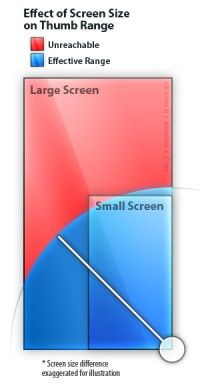
I’ve been using the iPhone for 3 generations. Right now I’m testing a Galaxy Nexus. If they made the same exact phone in a size that’s actually comfortable for one-hand use, I might call myself an Android convert. Curse you 4″+ screens and the awful fad that you are!

For me, the 4.65″ screen on the Galaxy Nexus is just too big. I constantly have to shuffle the phone around in my hand because Android places the two most frequently used aspects of the interface (the menu buttons and the notification drawer) at opposite ends of the phone. The size of the phone and the required shuffling means that I’ve got a poor grip on it, and I’ve been rather worried about dropping it during use. Again, those with larger hands will not have the same issue at 4.65″, but at some point they will run into the same problem.

Android Handset Screen Size Over Time

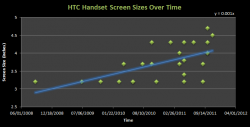
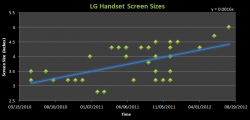
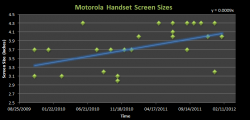
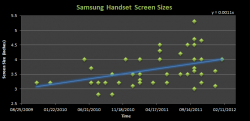
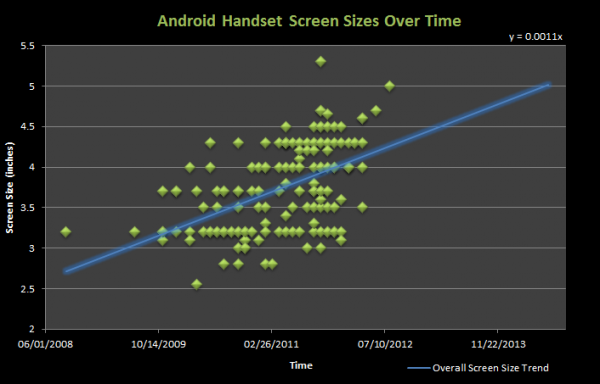
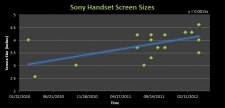
To show the trends of Android smartphone screen sizes over time, I compiled screen size and release date data from 155 smartphones from five major manufacturers (Motorola, Samsung, HTC, Sony, LG). I’d like to thank PDADB.net for their comprehensive release date info. (click to enlarge graphs)
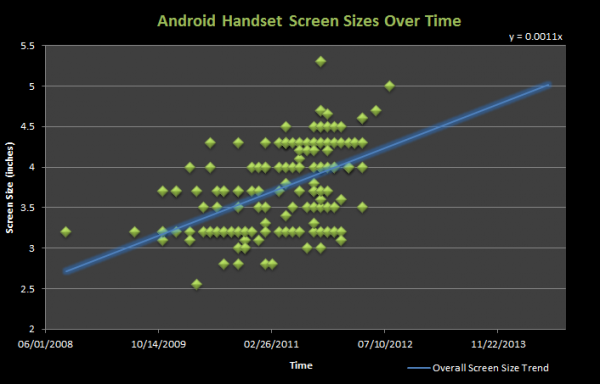
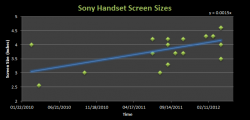


As you can see, since the introduction of the 3.2″ HTC Dream / G1, screen sizes have consistently increased. Today we’re seeing 4″, 4.5″, 4.7″, 5″, and even 5.3″ smartphones! A simple projection (seen on the main chart) suggests that before 2013 is out, many handsets will have 5″ screens, while the flagship phones of that time may have even larger screens (if this trend continues) of 5.5″ or perhaps 6″.

With a slope of 0.0016, LG is increasing its Android smartphone screen sizes the most rapidly of these five manufactures. Despite pioneering some of the largest phones on the market at certain points in the timeline, Motorola is actually showing the slowest rate of increase in Android smartphone screen size with a slope of 0.0009, but of course this isn’t very far off from the leader!

Why is This Happening?

A good question to ask is what’s prompting the growth in screen size. It seems natural for manufacturers to have experimented with screen sizes as the platform grew legs. Different screen sizes are a point of differentiation for an Android phone manufacturer — a way to stand out in a sea of similar options. Bigger screens were also an easy way for companies to try to beat out the iPhone on features, even if the ‘bigger is better’ argument doesn’t hold much water in this case. Now it seems to have turned into a snowball effect whereby manufacturers are trying to one-up each other to have the biggest screen in town (all the while, Apple has stuck with 3.5″ since the introduction of their handsets). You wouldn’t believe how many times I’ve heard the phrase “biggest and baddest” when marketers are referring to a new Android phone. They use this phrase as though bigger is always better, but I must say — when it comes to comfortable one-handed smartphone use — it is not.

Where Does It Stop?

My question is this: where do we draw the line? As I mentioned, despite variations in hand sizes, everyone reaches a limit of comfortable one-hand usability at some point. I don’t have the raw data to back it up, but I believe that Android smartphone screen sizes are rapidly surpassing the maximum size for comfortable one-handed use by the average Android customer. None of this is to say there aren’t advantages to having a larger screen (particularly when it comes to media viewing), but given that people much more frequently use their smartphones for apps rather than media viewing, the argument for surpassing a users one-handed comfort zone to provide a better media experience is a poor one.

It’s not so much that screen-sizes are increasing (the chart clearly shows that other sizes are still available), but the bothersome fact is that it’s near-impossible to get a flagship phone unless you’re willing to buy one of the massive phones on the market. If you want a phone that comes in a size that’s comfortable for one-handed use, you have to be willing to settle as a second-class Android citizen — the only options available to you will likely have slower processors, less RAM (and may be based on an older platform) than the newest and biggest flagship phone currently on the market.


 

Verizon’s Phone Leak, Visualized. Galaxy Tab 4G Coming in November (but which one?), Among Other LTE Devices

Tags: , , , , , , , , , , , , , , , , , , , , , , , , , ,


IGN managed to get a hold of what their source claims is an internal document listing launch dates for 14 upcoming devices. Swing by IGN to see the original document, but also hang here to see that I’ve taken the information and plotted it on a handy timeline for you (I am a visual person, after all). Be sure to click to bigify:

verizon phone leak

Among the devices listed are the Motorola Droid Bionic (I accidentally didn’t note it as being 4G), which has seen a number of delays, and the Motorola Xoom 4G upgrade, both of which we had already heard were coming in September, so corroboration makes this leak seem quite legit.

According to the leak, Verizon is set to add five additional 4G LTE devices to their shelves that weren’t part of their initial 4G lineup. Those devices include:

  • Samsung Stratosphere
  • Blackberry Curve 9370
  • HTC Vigor
  • LG Revolution 2
  • Samsung Galaxy Tab 4G

The Droid Bionic and Xoom were part of Verizon’s early 4G lineup, so we already knew they were coming down the line. The ones listed above, however, are mostly new.

I say mostly because we’ve been eyeing the Galaxy Tab 4G which, at first, was announced as a 4G version of the original Galaxy Tab 7, but it may end up being the Galaxy Tab 8.9, instead. Verizon had it listed as the “P8” on the leaked chart, but it is unclear exactly what that means. Whichever form it comes in, the leak tells us that it’ll be happening sometime in November.

The HTC Vigor is specifically designated as being a replacement for the HTC Thunderbolt which was Verizon’s very first 4G device. Similarly, the Revolution 2 is going to replace the… wait for it… Revolution (bet you didn’t see that one coming!), which I’m hoping will provide better battery life, faster charging, and better standby than the original.

The Blackberry PlayBook is also listed on the leaked list, but its launch date is listed as “TBD”.

What’s obviously missing here is any information regarding the iPhone 5 or iPad 3, but any information regarding those devices is unlikely to be known outside of Apple until they announce it publicly. Still, that doesn’t stop us from speculating.

If all of this turns out to be true, Verizon has a powerful pre-holiday lineup; I can only hope that the other major carriers have such an exciting group of devices ready to go!

via: The Droid Guy

source: IGN Gear

LG Revolution Full Review

Tags: , , , , , , , , ,


DSC_5161Verizon is well on the way launching all 6 of the initial 4G devices on their roadmap. First was the HTC Thunderbolt, then the Samsung Droid Charge, and now LG’s Revolution. I was expecting the LG Revolution to represent a lesser performing and lower cost entry into the 4G-equipped phone sector though it’s actually priced up there with the others, but also performing better than I had expected.

Hardware Tour:

DSC_5109

DSC_5114

DSC_5111

DSC_5110

Specs:

  • Snapdragon CPU @ 1GHz
  • 368MB of RAM
  • 4.3” capacitive touchscreen @ 800×480
  • Android 2.2.2 with Bing search and custom skinning
  • 16GB memory stick included
  • 4G LTE data connectivity
  • 5MP rear-facing camera with flash (720p HD recording)
  • 1.3MP front-facing camera
  • WiFi b/g/n & Bluetooth 3.0
  • 6.06 oz. (5.03”x2.64”x0.52”)

LG Revolution Gallery

Tags: , , , , ,


DSC_5101The LG Revolution, Verizon’s third 4G phone, has been unboxed, and now we’ve got a full gallery ready for your perusal. Get a sneak peek at the shots you’ll find in our eventual full review below:

See the full LG Revolution gallery here

DSC_5105 DSC_5117

DSC_5121 DSC_5133

DSC_5123 DSC_5161

LG Revolution Unboxing and Flash Test (it handles 720p!) [video]

Tags: , , , , , , , , , , , ,


We’ve got the LG Revolution on hand and have prepared an unboxing video for you which also features a flash test. I’m happy to report (and somewhat impressed) that the LG Revolution has so far handled YouTube 720p flash video quite well. This surprised me because the Revolution is using a 1GHz Snapdragon CPU as opposed to Nvidia’s Tegra. Have a look below:

Field Guide: Verizon’s Six Upcoming 4G Devices – 4 Smartphones, 2 Tablets – Pics, Specs, and More

Tags: , , , , , , , , , , , , , , , , , , ,


verizon 4g lte devicesWith the launch of Verizon’s first 4G (LTE) smartphone, the HTC Thunderbolt, just behind us I thought it’d be a good time to lay down an overview of Verizon’s initial 4G device lineup. If you’re planning on jumping into the 4G action, listen up: these are the devices that you’ll be seeing right down the road.

At Verizon’s CES 2011 keynote, the company announced a goal to launch 10 4G devices by mid-year (which is now being refined to “summer”). Of those 10 devices, four are smartphones and two are tablets.

Availability:

All of the devices listed in this article will be available by this summer, according to Verizon.

As for 4G coverage, Verizon is continuing to roll out coverage to more regions. Take a look at the following map to see if your area is already 4G enabled, or marked as coming in 2011 (be sure to read the map legend!)

http://network4g.verizonwireless.com/pdf/VZW_4G_LTE_Coverage_Map.pdf

We saw the launch of the first of Verizon’s four upcoming 4G phones with the HTC Thunderbolt just a few days ago:

HTC Thunderbolt

htc thunderbolt front-backThe sleek looking HTC Thunderbolt is already in the hands of consumers, and we’ve seen some incredible 4G speed tests so far – speeds that easily outperform my home broadband connection (and probably yours too!). Check out this video from GottabeMobile.com of the Thunderbolt benchmarking 24.30Mbps download and 16.60Mbps upload:

.

This is no doubt very impressive, but be forewarned: Verizon does not anticipate that customers will see these speeds once the 4G waves become saturated with users. Verizon has been claiming from the beginning of their LTE campaign that users should expect 5-12Mbps download and 2-5Mbps upload.

They are getting great press thanks to the ridiculous speed that the Thunderbolt achieves and even though the speed will reduce as 4G devices become more widespread, they are going to benefit greatly because the idea that “Verizon’s 4G is fast” is going to stick around in the heads of the general public much more easily than specific figures. When customers pick up a 4G phone, even after the speeds have come down to 5-12Mbps, they’ll likely still be impressed with the speed if they are coming from 3G.

Specs:

The HTC Thunderbolt isn’t just a data speed-demon, it’s also a top-of-the-line smartphone packed with some impressive hardware:

  • Android 2.2 with HTC Sense interface (unfortunately not 2.3!)
  • Qualcomm MSM8655 Snapdragon CPU @ 1GHz (Qualcomm MDM9600 chipset with LTE support)
  • 768MB of RAM
  • 8GB of built-in memory + 32GB pre-installed Micro-SD card
  • 4.3” capacitive touchscreen @ 800×480
  • 8MP rear camera with dual-LED flash and autofocus, 1.3MP front-facing camera
  • WiFi b/g/n & Bluetooth 2.1
  • GPS, FM radio

It’s also got a sweet kickstand – a hallmark of several HTC devices:

htc thunderbolt stand

I’m disappointed that it isn’t using running Android 2.3, but it seems like almost every upcoming device has this in common with the Thunderbolt. If we’re lucky, we’ll see an update to 2.3 down the road.

What it doesn’t have in common with most other smartphones on the market today is that the front-facing camera is 1.3MP instead of 0.3MP, this should offer a nice boost in video-calling quality (especially over 4G where the bandwidth is there for higher quality video).

Reviews:

If you’re looking for some quality info about the Thunderbolt, check out these reviews:

Next Up: Motorola Droid Bionic

LG Optimus Pad at MWC.

Tags: , , , , ,


image

image

Tegra and Honeycomb seem to be everywhere at MWC. We spotted the Acer Iconia 100 yesterday but that seems to be the only 7″-er. Everything else is 10″. At this early stage in the Honeycomb lifeline there isn’t a lot of time for manufacturers to make huge differentiation in the software layers so LG have chosen to go the hardware route on their tablet and have added 3D cameras. Unfortunately I wasn’t able to test them.

With Honeycomb being so new its difficult to come to any conclusions but I saw an amazingly sharp and high-contrast screen that was let down by a user interface that should be a lot, lot smoother.

On the back you have a removable panel which seems to be only for the Sim card. I think I must have missed something there but I’m sure there’s no removable battery. Build quality overall seems very good and the gaming experience was an obvious step up from what I’ve seen on other devices. If developers jump on the bandwagon and optimise for Tegra, it will a real advantage in the gaming space.

With that 3D feature in the device I’m certainly not expecting it to be cheap and I wonder, is anyone really crying out for 3D camera like this?

More Honeycomb News: LG G-Slate to Launch on T-Mobile

Tags: , , , ,


The Honeycomb news isn’t stopping today. I’m actually surprised that we haven’t seen a formal new release from Google yet! Details are likely to come out in the next few hours for the G-Slate but for the time being, at least we know it’s real. Not much to see of the device in the video which appears to be a variant of the Honeycomb video that has been doing the rounds today.

The video is accompanied by this description:

Here’s an exclusive look at the upcoming Android™ Honeycomb-powered T-Mobile® G-Slate™ with Google™, by LG. Expected to be available in coming months, the G-Slate will be the first 4G tablet from the two companies powered by Android 3.0 (Honeycomb), the upcoming version of Google’s Android platform optimized for tablets.


Standby for more details soon.

Update: TMobile appear to be putting up more Honeycomb videos in their YouTube CES channel including this one of the browser. notice the tabs

LG Gets Official with the Optimus Black

Tags: , , , , , ,


크기변환_Optimus_Black

Today at CES LG have gone official with their latest Android smartphone. It sports a 4-inch NOVA display which LG claim is “the brightest, clearest and most readable” mobile screen available, promising to be extremely bright while at the same time being more power efficient than both LCD and AMOLED mobile screens.

If the name doesn’t give it away, the phone has a black finish and LG also claims it’s the worlds slimmest mobile phone at an impressive 9.2 mm, which is 0.1 mm thinner than Apple’s iPhone 4. It will be interesting to see if it can still claim to be the worlds slimmest phone by the end of CES.

The Optimus Black seems very similar to the LG Optimus 2X that was announced late last year, however the LG press release gives no indication on what processor is at the heart of this phone leaving me feeling sceptical on whether this device is Tegra 2 powered like the Optimus 2X.

LG say this is also the worlds first ‘WiFi-Direct’ phone which is a very interesting technology that allows direct data transfers between enabled devices.

The Optimus Black will launch with Android 2.2 preinstalled however LG plan on updating the device to Gingerbread which they claim will also provide higher quality video calling through it’s 2 megapixel front facing camera.

This appears to be a very promising phone and I look forward to a hands on when it launches globally in the first half of 2011.

Source: LG

LG GW990 Intel Moorestown Smartphone Video Demo.

Tags: , ,


Intel have announced more details of their Moorestown based work with LG. The GW990 should be available in Q3 2010 and will run Moblin 2.1 for handhelds. More details on MIDMoves

Gallery of GW990 at the LG booth

Specifications confirmed:

  • Intel Moorestown platform with HD 720p encoding and 1080p decoding.
  • 5mp cam (ingle led flash)
  • 1850mah (single cell I assume) battery
  • A-GPS
  • Compass
  • HSDPA/HSUPA
  • Q3 availability

LG GW990

We’ll be at MWC where Intel are almost certainly going to show more Moorestown devices. Nokia were mentioned in the keynote so maybe we’ll see an Intel Nokia smartphone.